Monday, 24 March 2025

2025 Inquiry

 This year is another year of new learning with our school taking on the Numicon Maths Programme. As a Team we had been intending to focus our Inquiry into the Numicon programme. However there was a delay with the Numicon equipment and then once it arrived and we got underway we realised it was going to take a bit to get our heads arounds teaching in a different way. With this in mind as a team we decided to keep our Inquiry focus on reading. 

In team 2 we have now all completed the BSLA training and have been consolidating all the new learning from last year into our literacy programme. As many of the components of BSLA are quite sequential and prescriptive we thought it would be better to focus our Inquiry on an aspect of the programme as equally important but less prescribed,  comprehension.

With such a focus on the decoding of texts there was a concern that the children would not develop the necessary comprehension skills needed, once switching off the Phonics Plus texts, to the more sophisticated Ready to Read texts (in terms of story and themes).Altough it is important to acknowledge that the BSLA programme does have some strong comprehension components particularly in the whole class 'Reading To' section. It is here children are introduced to story structure and themes, and are exposed to, and unpack, sophisticated language. 

However we felt it was important to be more intentional in including a comprehension focus in our small group teaching.

The challenge is time, as the small group teaching already has a strong focus on a particular language pattern that is being covered, and does not allow for much time to be spent on comprehension. However this is our goal.

We have chosen children as our priority learners. For me I have chosed 2 groups of children, 1 group who are just at about where they should be in the BSLA programme, and another group who is working just below where they should be.

The first group is fairly competent at decoding texts. The second are less fluent at decoding and so a lot of their thinking is taken up with getting the words off the page.

With these priority learners we are recording a teaching lesson on Vosaic with a focus on comprehension to reflect firstly on our own teaching; whether we are allowing children the time to discuss and compare their ideas, and back up their thoughts. But secondly to have a record of the children's ability and skills at unpacking a text and discussing their understanding.

Friday, 6 December 2024

2024 Reflection

 It has been a full on year with learning the new BSLA teaching for me. My focus for the year has been definitely on improving my knowledge and delivery of all the components of this programme.

It has been encouraging to see the gains made by students in having a better way to decode and problem-solve when reading texts. It has also been great to see the building o f comprehension and oral language when discussing the reading to text, which is a focus for a week. I had inititally thought that continuing to discuss a text for the week would possibly take away from the joy of reading, but this has not been the case. Children are enthusiastic about the conversations they have and by the end of the week the more reluctant speakers are feeling more confident to contribute.

I look forward to contuing to build by knoweldge and practice next year.


Friday, 23 February 2024

Inquiry 2024

Better Start Literacy Approach 

This year I am back in a Year 2 class but am excited to be undertaking the BSLA training. I am looking forward to learning this approach to literacy and seeing what benefits it can have for my class.

I am also continuing to spend part of each day taking 2 children for reading recovery and also taking 4 students in a Tier 2 daily lesson.

The BSLA planning is fairly set and there is the expectation that I will be following the planning and lessons provided. So I have decided to focus on the children in my Tier 2 group for my Inquiry. 

I am interested in seeing not only what the intervention can achieve over 10 or so weeks in terms of reading and writing improvement but am keen to have a particular focus on oral aquisition as well as I see this is a real lack and stumbling block. So I will be including in each lesson a particular focus on vocabulary building and retelling.


Monday, 3 April 2023

Inquiry 2023

 A few years ago at a Manaiakalani TOD I went to a workshop with Jo Gormly from Tamaki Primary. She had been working with Jannie Van Hees on ways to develop a rich oral language classroom.

This was her Inquiry Hypothesis

Developing oral language through short high-interest topics and real-life experiences, with a focus on intensive oral language acquisition, will create an environment of language in abundance.

At the time I didn't have my own class to have a go at implementing some of her ideas and practices so now that I do have my own class I am keen to see what difference a real focus on extending the acquisition and practice of oral language vocabulary and structures can have on lifting student engagement and achievement in writing.

Over 10 years ago when I was teaching a Year 5 class, we also had considerable P.D. with Jannie Van Hees. At the time,  the positive impact her programme had on writing was quickly apparent. However I noticed over the following years, as her practice became re- interpreted and morphed slightly, the focus on gifting vocabulary more in isolation (as opposed to a constant revisiting and re-using in different contexts) lead to some less positive outcomes particularly for children learning to write.  I noticed that there was a trend for children to become so dependent on gifted language and the spelling of these words that they were less risk-takers. If they didn't know a word they needed to be told rather than having a go themselves. I noticed that some children were becoming more reluctant at writing.

In thinking about my inquiry for this year I realise that there needs to be a dual emphasis. - on the one hand having an explosion of vocabulary learning. and practising by using and re-using this vocab in a multitude of ways, but on the other hand there also needs to be a simultaneous  focus of learning the skills for writing - the nuts and bolts for being able to write down ideas quickly and confidently through a solid knowledge of letter sounds and word parts and a bank of known high frequency words.

So next term I plan to rearrange the timetable to allow for an inquiry focussed activity in the 1st block which will also have a strong oral language focus. This activity will then become the focus for writing. Children's writing skills will simultaneously be developed through small group instruction on letter sounds, clapping words into parts, making and breaking words, using Elkonin boxes etc.  

 Initially I plan to carry out an oral language assessment on a targeted group of children, which along with their e-asttle writing test will be a baseline starting point. There is an oral language test that Jannie created that I would like to look into as well as doing a Record of Oral Language test.

We will plan in 2 week slots with a strong clear topic of interest for each of those 2 weeks. A bank of related vocabulary will accompany every 2 week topic. Every opportunity will be found for children to use and re-use this vocab and to practise it in different contexts with different sentence structures.

Inquiry Focus Question:

Can a focus on intensive oral language acquisition through short high-interest topics and real-life experiences, in conjunction with the teaching of sound writing skills, help to significantly improve children's writing.

Thursday, 22 July 2021

Inquiry 2021

 This year I have been lucky enough to have had two terms without my own class. I have been able to continue trying to implement an AWS programme in the Year 5/6 block and the Intermediate block. I have had the support of 3 support workers who have learnt the programme and are timetabled in to doing the programme with small groups 4x a week. Having 4 solid lessons a week has not been entirely consistent with the support workers being called away to other commitments such as sports. However on the whole for the 40 children involved they have fairly consistently had at least 2 if not 3 or 4 lessons per week. 

With about 12 of the students' attendance is also an area of concern.

Thoughts so far

Having done the mid year running records on some of the AWS children it becomes evident that at about a 9 year reading age some of the students are mostly able to decode but fail the comprehension. The thought is that too much of their focus is still on decoding that it is too draining to focus on the comprehension of the text simultaneously. For some I would say this is accurate, but for others who appear to have unlocked the key to decoding I wonder if the years of reading well below their age have left a gap in exposure to a wide range of vocabulary and complexity of ideas that they are unable to bridge quickly now that they are actually able to read (decode) these more complex texts. 

My next question is whether the AWS programme is still suitable. Could it be modified to include a greater focus on the meaning and use of vocabulary, perhaps as part of the 'big word' component. With each big word I explain what it means and how you would use it in context but without this word being revisited it is a lost opportunity.

Another thought is that we really have to ensure that children who are reading well below are getting exposed to this more sophisticated language and ideas through a strong oral language focus. Just because children are unable to read or write certain words doesn't mean they are unable to speak, understand and use them. It is of even more importance to these children  as they are not encountering a broad range of language in the simple texts they are able to read - texts that don't relate to their level of maturity of thinking.

Saturday, 22 August 2020

Level 2 Learning and AWS

 When New Zealand went into Lockdown the AWS programme went on hold. A few of the children worked with me doing some elements of AWS online but most didn't. When we moved into Level 2, I was part of the team teaching in the Year 5 space but due to the distancing requirements small group teaching was not incorporated.

During Lockdown the online learning the year 5/6 team did was based around a theme. The literacy, numeracy and inquiry tasks all related to this theme with daily variations. My tasks predominantly, for the rest of term 2, was to produce more supportive tasks on the same themes for those whose literacy levels meant they found it otherwise difficult to independently access the learning.

The most noticeable positive effect of this was the level of engagement and motivation. These children (who typically have had tasks and activities that differed from what the rest of their peers were doing, due to the level of their literacy skills) were now exploring the same topics and doing similar activities. 

Not long after small group teaching was back up and running, the AWS programme groups also started up again. (Week 10 Term 2) However the children continued doing the supported independent tasks related to the theme. At this point also we added in an extra 13 children so there were now 24 children from the 2 classes on the programme ranging from Level 3 up to Level 18. They were split into 5 different groups. With each group taking about 20 minutes (30 minutes with groups where an instructional reading lesson was also included) I managed to see 4 groups each day. As there were mornings where Kiwisport was timetabled in, this meant that the groups were getting on the whole 3 AWS lessons each week. In the second to last week of term (Week 11) it was evident that the New Entrant numbers were building so I would need to be starting the new class in Term 3. At this point I started training one of the support workers to take over the AWS lessons. She has continued doing this for Term 3 until we went into lockdown again.

Even with a disjointed attempt to implement the AWS programme into the Year 5 classes this year due to Covid-19, the positive impact it has had is evident (a view supported by the classroom teachers involved). Children who have made little progress in their 4-5 years of schooling are starting to make shifts. The children are keen to come to the lessons and feel success. Incorporating it into the normal literacy lesson rather than as a withdrawal group I feel has also been very positive. It has meant the children  are not missing out on other activities and it is just part of their literacy learning. When there have been circumstances where a group have missed their lesson they are disappointed and ask when it is their turn. 

Training up a support worker to continue the lessons has also been a positive factor. This has meant the children are also able to continue guided literacy lessons with their teacher so the AWS lessons are on top of this. 

This however highlights a point of difference with what is advised in the AWS programme. (Something we need to keep in mind and monitor.) The programme suggests that the reading that should accompany the lessons is only that which reinforces the emphasis on learning the basic sound chunks they are practising in the fluency sheets. However this has been something I am not convinced about as the texts provided are very low level. This means there are not really opportunities for the children to practise all the other skills needed to be a successful reader. I understand there is the need for the children to retrain their brains away from using their go to strategies, strategies which will only get them to a certain level and no further without the basic phonological knowledge they need to master. However the length of time it takes to work through the different fluency sheets means that is a long time of reading very low level texts. I feel that if children were introduced to the AWS programme earlier or if we were more deliberate in ensuring all our children in Year 1 and 2 developed these sound phonological skills, these books would then be more useful. 

My approach to dealing with this problem was to incorporate the supported texts (texts with audio) so children were still able to develop  comprehension skills that were more related to their thinking level rather than their reading level. However we also have continued to have guided lessons at their instructional reading level to help them develop all the other skills they need related to becoming good readers. But this does mean they are encountering words that don't fit the phonological patterns they are trying to get fluency at. At the moment we are not using the texts included at all. On reflection maybe we could be incorporating them also into the programme, but my gut feeling is that it would not be wise to take out any of the components we currently do. Another factor I am not sure where it fits in is the learning of the basic words '(words that most often don't fit the most common phonological rules the children are learning in AWS.) These are both areas we need to monitor and reflect on to see if we need to make changes. 

On the whole though I feel the move to incorporating the AWS into the normal literacy classroom programme has been very successful. It has meant that one teacher or support worker has been able to have a significant impact on many (24) children in a daily morning block of 2 hours.  

Friday, 21 August 2020

Agility With Sound in the Classroom.

For Term 1 of 2020 our new entrant enrolment numbers meant I was not needed in the classroom. Instead I was able to spend time getting an Agility With Sound programme set up in the Year 5 space. After testing all the children, who were reading well below their Year level, I set up 3 groups involving 11 children whose reading age ranged from Level 9 through to Level 18. Of these children there were a couple who had had a brief introduction to AWS at the end of 2019.

I started taking these children for lessons in Week 3 starting with learning the independent tasks they would be expected to do.  In week 5 I started taking them for AWS lessons also. The idea was to get these children familiar with the routines and expectations and then add the other identified children once we had got underway. The intention was also to support the teachers in moving to taking over the AWS lessons once the children had become familiar with the routines, In general the children I took predominantly spent the literacy block being under my supervision and completed both reading and writing tasks I had set them. 

This initial setting up phase took longer than I expected. Some of the children were easily off task during their independent work and needed lots of check-ins and monitoring. On the whole though the children were happy about doing the programme in class and enjoyed the lessons.. There definitely felt an improvement in the engagement and focus when compared to the previous year's groups where I had withdrawal groups after morning tea and in the afternoons and the children were often missing activities they would liked to have been doing.

Here is an example of the daily tasks.

Monday, 20 January 2020

2019 Overview of Agility With Sound

AGILITY WITH SOUND


The Agility With Sound intervention was a pilot to gauge its efficacy in supporting those students in
Year 5  who were reading well below their peers. This Programme was designed by Betsy Sewell as an
Intervention for older children who have struggled to learn to read.  Midway in term 1 students were
selected and tested according to Agility with Sounds tests. This highlighted children who had a
weakness in sound to letter knowledge. We started in Week 6 with 3 groups of 4 children for 3 half hour
sessions a week. This continued consistently throughout Term 2.


However in Term 3, I was required temporarily to be  fulltime in our New Entrant space as we had a new
teacher start. At this time though I supported Hannah West initially and then Migi Sio also into
incorporating the Agility of Sound lessons into their Year 5 classroom reading programme with the
children who had become familiar with it in my small groups. This meant that I was able to test and take
on 7 more children, starting in Week 4. Unfortunately as the New Entrant enrolments had increased, by
Week 7 I was required to be back fulltime in my classroom so the withdrawal group Agility With Sound
programme was unable to be continued.


11 students initially started in Term 1 Week 6. However one left Pt England School, and one got replaced
after the first term because of her attendance. Four other students were taken on
(Two in Term 1 Week 8, one in Week 9 and one in Term 2 Week 1).
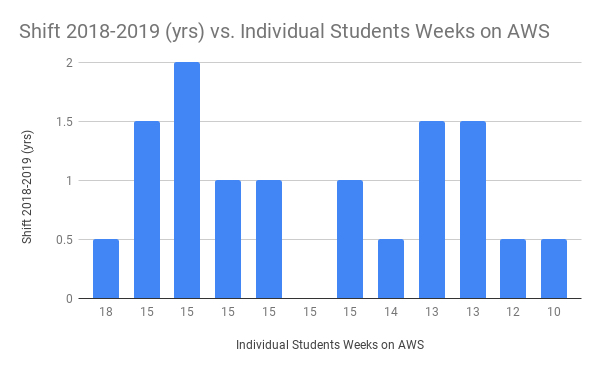
Of these students, seven had a 15 week, and one a 10 week intervention with me then continued the
programme with their teacher. Four of these students continued the withdrawal programme with the
new intake of students in Term 3 which was able to be continued for only 3 more weeks.


Despite the programme not being as consistent as was hoped, both the classroom teachers and I could
see that the children’s decoding skills increased as did their confidence. This was particularly evident
with the students who had consistent attendance and who practised at home. There were some pleasing
shifts in reading levels for a few, while others who, although didn’t make the expected gain, still did shift. 


The transitioning of the programme into the classrooms was well supported. I felt it was really important
that the resources needed for it had to be able to be managed well, so that there was little setting up time.
  This enabled as many components as possible to be incorporated in the time available for each group.
This meant also establishing systems where the students could practise certain elements independent
of the teacher. The teachers involved felt that the classroom programme we established together was
both manageable and effective.


Chart Showing Individual Students’ Reading Progress In Relation To Weeks On
Withdrawal  Programme
                                                               Individual Students (Weeks on AWS) 


Sunday, 26 May 2019

Agility With Sound: Moving Towards the Classroom

I have continued taking my 3 groups of  four Year 5 students 3 times a week. I had to replace 1 student as their attendance was too intermittent, and 1 student left. This meant I was able to take on 2 other students.
We have continued working through the fluency sheets of reading 3 letter words, (consonant-vowel-consonant) at speed. The children have made progress with this particularly those who have been regularly practising at home. They have made good improvements in being able to hear the sounds in large words, and are becoming more consistent in knowing which vowels they hear and the endings.
I have been regularly starting each session with a dictated sentence which includes the word they were trying to learn the day before as well as a range of 3 letters words.

As it is not certain I will be able to continue this programme longer than this term I decided that it was important to try and get it running in the classroom with the classroom teachers. I modelled a session with the teachers and am in the process of setting them up the resources they will need and a plan to hopefully start next week.

Resources
ipads/tablets with the wordchain app.


fluency sheets
multiple colours of whiteboard markers

letter tiles (1 set for each child in the group)


Lesson Sequence
Dictated sentence - this could be done independently listening to a prerecorded sentence on the ipad. Best to mark it together as a group  with the teacher though.
Fluency sheet - practice by highlighting all the words with the same rhyme (practising the fluency sheet independently is also a good idea)
Timing Fluency: How many can be read correctly in 1 minute. (Really needs to be done with the teacher or support worker as mistakes need to be corrected before continuing))
Decoding a big word or Wordbuilding. Can be done as a group. Each child needs a set of letter tiles.
Learning this word: Split into parts/say the sounds randomly (turning a tile over til all are upside down/Writing word. (This word learning can be done as a group)

Sunday, 31 March 2019

Agility With Sound 3 weeks in.

Where We Are At.

I have now been taking 3 groups of 4 children for a 1/2 hour Agility With Sound session  Monday - Wednesday for 3 weeks. 2 of the children started only a week ago and two children have left Pt England after they had started with me. I will now be picking up one other.

In only 3 weeks I have already seen a significant improvement in the children's ability to read at speed their fluency sheets of 3 letter words.

Here is a typical sample from the initial testing which highlights some of the difficulty the children have with hearing and recording sounds.


                                                      vat  beg  hid  mop   bud
                                                      mash   thud   chap   moth
                                                            sped  snip  flop


PretestWEEK 7 FLUENCY TEST
no √ in 1 min
3151
3165
1648
652
1329
1449
629
1418
1046
545
259

 Also I can see significant improvement in the children being able to break words into parts, hear the sounds within the parts and find the corresponding letter tiles to build the word. Following this we randomly check the sounds of the letters turning the tiles over until they can say the sounds of each letter or ending in any order with the letters all hidden. From this they are mostly reasonably confident at writing the word on the whiteboard by themselves. These words are generally multisyllabic words, such as flustering, continent, and blistered. For a child who has really struggled to write the simplest words they encountered in their initial test such as beg, vet, mop, being able to write and remember these much more difficult words is extremely motivating and empowering.

At the moment the focus is solely on gainly fluency at these chunks and getting a better understanding at how words can be broken apart and put together. There are texts which support this learning which are introduced only once the children have made a significant jump in their fluency of the word chunks. These books are carefully written to contain predominantly words that follow the common sounds the letters  make (particularly the vowels). They are also free of illustrations for the reason that these children compensate for their lack of word/letter sound processing by over-using all the visual clues they can including illustrations, as well as the shape of a word. The aim is to rewire the patterns and pathways in their brain to be able to use the grapho-phonic side of their brain rather than predominantly the visual.

Where To From Here?
Having trialled this programme I can see how easily it could be supported in the classroom or with support workers. It is fairly straightforward and structured so is easy to learn without lots of PD. I was having a conversation with Betsy the other day and she mentioned a couple of schools that are trying to implement it with more students. One school is a small country school of 45 student and they are doing it schoolwide. Another is an intermediate where they have implemented it in a specifically chosen classroom where all the children in the class are taught using this method. Betsy was highlighting how getting the classroom teachers on board for reinforcing the programme in their group teaching of these children is significant in seeing these children progress faster.  This is an area I would like to next explore, particularly as it is uncertain as to whether we have the funding to continue me having time out of the classroom to implement it.

The other focus I have is looking at how we can avoid having so many children in need of such a programme in the first place.
It has become evident to me that right from the early literacy learning we engage our 5 year olds in, we are unwittingly supporting and strengthening them to be using the visual sides of their brains. Most of the high frequency words we get the children to learn require that they learn it as a whole, as they are words that don't follow the typical sounds associated with each letter: said, come, look, a, here, are, the, my, for, go, to. The PM readers very early on require children to learn these words and in fact have very few words that children are able to decode using their letter/sound knowledge.
Many children are able to integrate the different strategies in learning to read, such as  using meaning, syntax as well as grapho-phonic cues. However too many of our children struggle, and have an imbalance in the strategies they use, with minimal focus on the letter/sound element. This is compounded by the fact that the vowels sounds in particular, in the Polynesian languages including Maori are so different to English.

With my new entrant children I have tried this term to be more deliberate at doing making and breaking with the magnetic letters daily. This involves using a high frequency word (generally the ones that do have the common sounds) and making new words by changing or adding  a letter
e.g. at - mat, cat, sat, fat, hat, bat, rat.
I have been surprised at how quickly they can catch on to this.
Now that the children mostly have some letter sounds they know I am going to adapt Betsy's fluency sheets of 3 letter words so that we can be practising them already. Hopefully this will help in avoiding having so many children who have big gaps in that knowledge. Another element Betsy is rigid about is not using the letter names but rather always referring to the letter by the predominant sound. I have also incorporated this into what we do.
All these components of Agility With Sound  I feel complement the Gwyneth Phillips reading programme that we know has worked successfully. I am keen to see how we can make the most of this programme and see the difference we can make with its implementation.

Here is a sample of how it all rolls.

Monday, 4 March 2019

2019 Inquiry

This year Toni our AP went to a PD session with Betsy Sewell. From having two dyslexic children of her own Betsy developed a programme 'Agility With Sound' for helping other children who have had difficulty with learning to read and write.

She explains how reading and writing is a relatively recent development for human brains which means that there is not a specific area designated in the brain for this. Most able English readers and writers use the part of their brain used for speech and sound, but often people who have difficulty learning to read and write use the visual part of their brain instead. The programme she has developed has a strong phonics base and helps to reestablish the pathways in the learner's brain back to using the speech/language area.


Children can surprisingly become relatively adept at using the visual side of their brain for literacy up to a certain level but will struggle as the texts become more difficult. In addition the demand on their brains is much greater trying to decipher text using the visual side, so this in turn compromises their ability to focus also on the comprehension of the text.

We had Betsy come to Pt England to give a quick overview of her programme. What she said really resonated so we have decided to try it with some of our year 5/6 students.

INQUIRY FOCUS
 I have decided to focus  my inquiry on seeing what shift in reading and writing we can get from a group of children who are reading and writing well below their chronological age using the Agility With Sound literacy programme.

PRETEST
The initial part of programme involves testing each child individually using a couple of specifically designed tests.  The first one is a spelling test where the child is at a whiteboard. You, as the recorder note down each attempt at spelling the word including changes they make. (This is key in helping to get an understanding of how the child is processing the information - what part of their brain they are using) It clearly highlights gaps or misconceptions in the child's phonological understanding, and also what they do know.
I found this test really eyeopening. To see these children really struggle with trying to spell even basic 3 letter words. To see them knowing that what they had written didn't 'look' quite right so added in a random letter to change that 'look' rather than listening for specific sounds.
Here are two examples.


The second part of the testing is a timed minute test seeing how many words they can read. These words are not high frequency words, rather words that are made up of the basic standard letter sounds. Starting with consonant-vowel-consonant, then adding in blends and multisyllabic.
The test shows how quick they are at processing letter/sounds and also highlights the misconceptions they have.


The final test is another spelling test where the words are made up words.

This programme has similarities to a few things I was trying to do in 2016 when I was taking some children for withdrawal literacy lessons. I had the realisation that the children in these groups had really poor grapho/phonic knowledge and their speed at processing and decoding was really slow and inaccurate. I had searched for activities people used for dyslexic children and came across a similar process which I used daily and felt made a difference.

I am really excited to be trialling Betsy's programme as it seems very specific and targeted. Although I don't think it is a programme you would teach everyone how to read and write I think there are components that complement our Gwyneth Phillips literacy really well which could possibly help avoid having so many children not connecting with the crucial side of their brain for so many years, ending up like the group I will have - children who have learnt inefficient and inaccurate strategies to help them read and write.

Saturday, 2 February 2019

Student Collaboration

From the same Teaching Channel site here's another clip that has some good reminders about ways to establish effective student collaboration.

https://www.teachingchannel.org/video/encourage-student-collaboration


Developing Mathematical Discussion


I came across this clip and thought it highlighted a really good way to start getting children into not only starting to notice similarities and differences but then also being able to express what they notice, explain their thinking and agree or disagree with others.
Lots of thinking going on with one simple activity.


Thursday, 24 January 2019

Teaching Self-Compassion

I came across this really interesting article

How Self-Compassion Supports Academic Motivation and Emotional Wellness

which ties in fantastically with what I have read about teaching growth mindset to children. The main idea is that teaching self compassion can help children develop resilience and strength.

"When a student develops self-compassion, the seat of motivation shifts.  Since internal value doesn’t depend on external achievement, it frees students up to experiment, take risks and try new paths.  “Self-compassion leads to learning goals instead of performance goals — such as trying again after messing up,” "

The article also says how teaching self-compassion is particularly valuable for children who have experienced trauma as it can even help children rewire the neural pathways associated with attachment. 

So another valuable element to somehow try and incorporate into our programme.


Monday, 22 October 2018

Play-Based Learning

While developing oral language continues to be a focus, this term we have decided to put a greater emphasis on exploring play-based learning.  From observing incidental interactions the children have had with each other while they are engaged in the independent play component of our programme, it has been obvious that there are many positive benefits with play.
Firstly the children are interacting with each other. They are negotiating, sharing ideas, responding to each other, expanding on other's ideas, agreeing, disagreeing, reasoning. In other words, not only developing important social skills but also language skills.
Secondly they are `being creative, such as coming up with innovative and different ways to play with equipment and designing and constructing like with the blocks and sand.

A focus for us now is to try and build on these positive attributes of play and help foster conditions for children to be really developing their thinking skills along with social skills. We are trying to give the children a greater variety of experiences to explore, and looking at ways of focussing their play in particular directions by setting challenges.

We also need to be looking at ways to record their exploring and thinking, in order to revisit their experiences, to help develop their language and thinking more.


Monday, 17 September 2018

Cynthia Greenleaf

Last week I went to the  Collaborative Reasoning PLG with Cynthia Greenleaf.


There were several similarities between her programme and DMIC: The establishment of group norms was important to help create an environment where all children felt they had a voice seemed to be the main one. Having a task where children have to think was another crossover.

In the seminar we were asked to do an activity in groups where we had to look at a picture of an 18th century crime scene, read the accompanying article about it and draw conclusions about what had happened. The most interesting thing highlighted for me was how important it was to have a scenario that was didn't emphasise a single dominant interpretation to help promote discussion, and develop the skill of supporting your views with evidence.

This made me wonder about some of the reasons I have been finding it very difficult establishing group norms in DMIC. The establishment of group norms has felt very teacher-led and forced for me. It hasn't seemed a natural process at all. Now I am wondering if particularly at our level when the problems are fairly simple, that there just isn't the need for discussion. It is trying to force something to happened when the reality there isn't enough depth to allow it to happen.

So my main take-away from this PLG was to try and establish these group norms in a different context, rather than trying to establish them in DMIC. Create some group discussions where children will have ideas to add. Where there are different interpretations so they can learn how to listen to others ideas and share their own but be able to help develop the skill of backing up their views. Then having learnt these skills in more natural and less contrived situations they can transfer these skills into the DMIC lessons.

My next to-do is to come up with some activities to help develop this.


I found the same activity online here.

Nigel Latta's A Curious Mind

Interestingly after having read the article on Mindfulness and Curiosity yesterday I also watched the latest episode of the Curious Mind by Nigel Latta which delved into several of the same issues. In the programme it highlighted schools which have included Mindfulness into their school philosophy and programme. They have found that not only has behaviour and empathy been impacted positively by this but academic success also.

Last year I started after lunch with a simple time to relax or rest. What was interesting was that that the children who had more behaviour issues found this really difficult to do. They just couldn't calm their minds enough to relax. As our 1 class turned into 2 it became more difficult so instead of continuing with it I abandoned it. I am beginning to see now that helping children develop the skill to be able to do this can be hugely valuable.


Sunday, 16 September 2018

Anxiety in children. Can curiosity be a remedy?

Here is a link to an interesting article about a way to try and retrack the transmittors in the brain. For children who suffer trauma or stress too often, their body's response of high levels of cortisol and adrenaline overrides rational and empathetic thoughts. This response can become a well-worn track in the brain because repeated experiences create brain connections. What is needed is to try and make better connections. Here is a possible way to try and help create these better connections.

Think I might try start doing this in our class.

https://www.enlightenpress.com.au/single-post/2018/08/30/Anxiety-in-children-Can-curiosity-be-a-remedy


Monday, 20 August 2018

New Focus

Over the past 2 terms in our New Entrant space we have been focussing a lot on how we can get our ever-expanding (space and children) area to work the most effectively it can. In the last holidays we opened up the wall between Rooms 14 and 15 so we now have 3 classrooms joined through openings. We also employed a new teacher Viola Masen to be the teacher for the new new entrants.
We have endeavoured to keep having time set aside for children to play while also continuing to juggle small group literacy teaching and DMIC teaching in maths.

Initially we had planned for quite a lot of mixing up of the 3 classes. We found however that the organisation of reorganising the children took up too much time. Having a new beginning teacher trying to get their head around a more complex organisational structure also meant that for the time being we felt it was better to stay in our set classes more. As time goes on we hope to change this up a bit more as it is really good to for children to have to identify with more than one teacher so they adjust better to change.

On the whole the space works well. It is good having the support of other teachers. Especially as there are often those unexpected occurrence when you might need to focus on one or two children.  It is also great that the children are able to interact with a wider range of children and are able to play with them in the classroom.

As we go forward we need to continue to try share our children across the 3 teachers more often. We need to keep working on developing good protocols for behaviour in our space i.e. noise level, tidying up after themselves, and continuing reinforcing a culture of being kind and sharing.

Thursday, 12 July 2018

Keeping in check

Constantly we face the dilemma of juggling the importance of play, (what we instinctively believe and what research has backed) with the expectations of where we need to get children by the age of 6. Observing the thinking, creativity and social skills evident whenever our children are playing continually proves this to me, but still I have to always keep myself in check when I find myself thinking and stressing about what level of reading they should be at, how many words they should know, what they should be able to count to.

Here is a child development expert's views. Well worth revisiting to remember not to over-emphasise traditional formal learning to the detriment of all other diverse areas of learning.


http://wikieducator.org/Professional_Inquiry/Nathan_Mikaere_Wallis

https://www.radionz.co.nz/national/programmes/ninetonoon/audio/2018635221/when-should-a-child-learn-to-write

https://www.youtube.com/watch?v=_UWbCnv1vno